

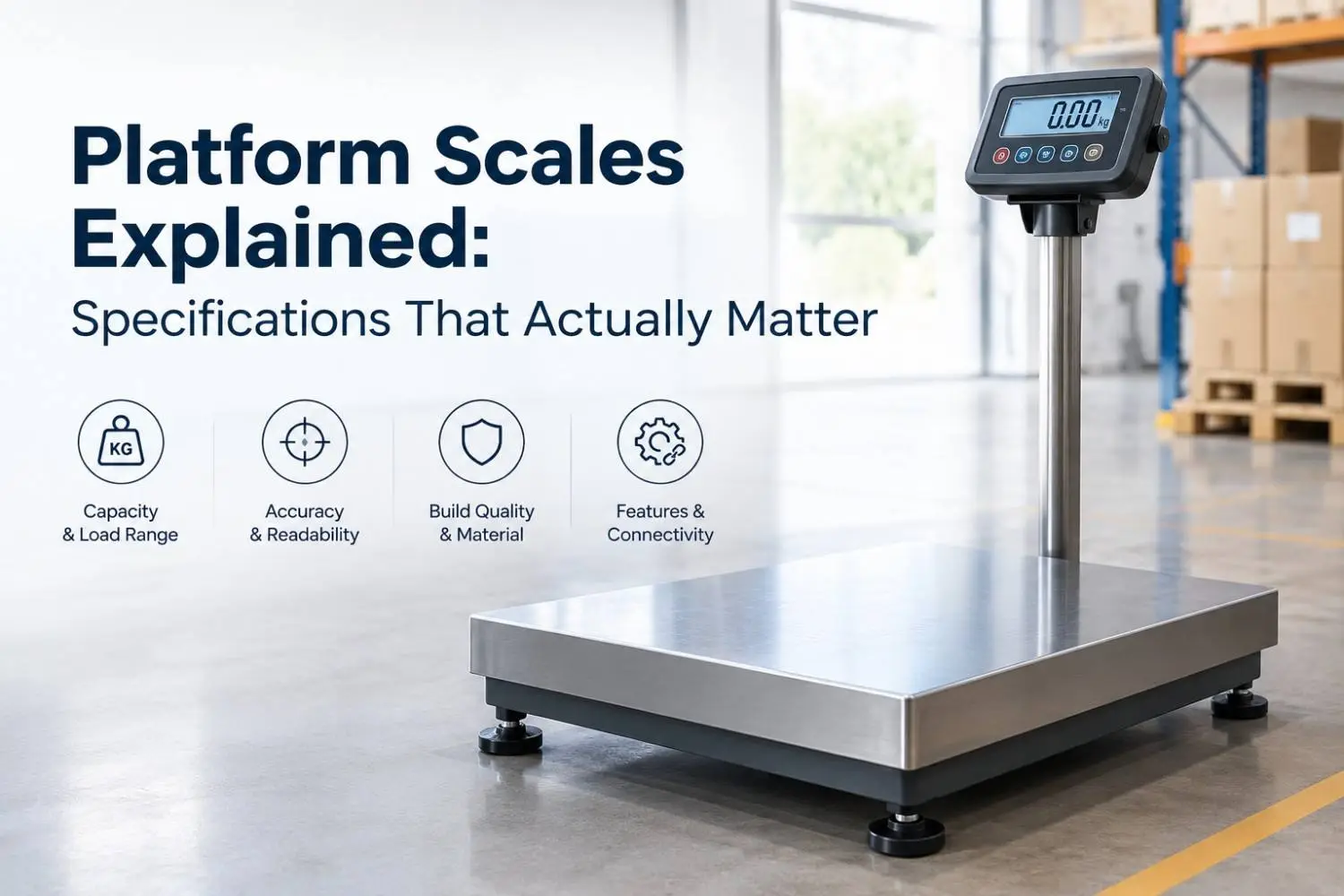
Shopping for a platform scale often means wading through spec sheets full of numbers capacity, readability, platform dimensions, accuracy class that can be hard to evaluate meaningfully without understanding how they actually translate into real-world performance. Many facilities end up choosing based on price or general reputation alone, which sometimes works out fine and sometimes results in equipment that technically meets the stated specifications while still underperforming for the specific application it’s meant to serve.
This guide breaks down the specifications that genuinely deserve attention when selecting a platform scale, and why some numbers on a spec sheet matter far more than others depending on your specific use case.
Capacity: Bigger Isn’t Automatically Better
It’s tempting to assume a higher capacity rating is simply a safer, more future-proof choice. In reality, capacity and precision trade off against each other in ways that make oversizing a genuine downside, not just an unnecessary expense. A scale rated for a much higher capacity than what you’ll typically weigh often sacrifices the fine-grained precision you’d get from a scale properly sized to your actual weight range, since the same underlying sensor technology has to spread its resolution across a wider overall range.
The right approach is to size capacity to your actual typical loads, with modest headroom for occasional heavier items, rather than defaulting to the highest capacity available “just in case.” This typically delivers better everyday accuracy without meaningfully compromising the scale’s ability to handle occasional larger loads within a reasonable margin. It’s also worth reviewing this decision periodically rather than treating it as fixed forever, since a facility’s typical load profile can shift meaningfully over a few years as product lines or processes change.
Readability and Why It’s Not the Same as Accuracy
Readability the smallest increment a scale’s display can show often gets confused with actual accuracy, but the two are distinct. A scale might display readings down to a very fine increment while still having a wider overall accuracy tolerance than that display suggests. Understanding a scale’s genuine accuracy class, not just its display readability, matters considerably more for applications where precise measurement directly affects billing, inventory accuracy, or quality control outcomes.
For most general industrial applications, a scale’s accuracy class relative to its intended use case is the more meaningful specification to evaluate closely, rather than being drawn in by an impressively fine display readability that doesn’t necessarily reflect genuine measurement precision.
Platform Size and Construction
Physical platform dimensions need to genuinely match what you’re weighing, with enough surface area to accommodate typical loads safely and stably, without excessive extra space that simply increases cost and footprint without practical benefit. Construction material matters just as much as dimensions; stainless steel construction suits washdown environments common in food processing, while painted or coated steel may be entirely adequate and more cost-effective for general industrial or warehouse use where washdown resistance isn’t a requirement.
Low-profile designs matter significantly for applications involving pallet jacks or manual wheeled equipment, where a scale that sits too high off the ground creates an awkward loading ramp that slows down routine operations and can create a safety hazard over repeated daily use.
Environmental Ratings for Your Actual Operating Conditions
A Platform Scale rated for a controlled indoor environment can perform very differently once exposed to the dust, temperature swings, and general wear of an active warehouse floor or outdoor loading area. Ingress protection ratings, which indicate how well an enclosure resists dust and moisture, are worth checking against your genuine operating environment rather than assuming a generic industrial rating will be adequate for every context.
Temperature compensation is another consideration that’s easy to overlook but genuinely matters for facilities operating in Saudi Arabia’s climate extremes. Scales without proper temperature compensation can drift meaningfully in accuracy as ambient temperature shifts throughout the day, which is a real concern for outdoor or poorly climate-controlled indoor spaces experiencing significant daily temperature swings.
Connectivity and Integration Options
Modern platform scales increasingly offer connectivity options, such as USB, serial, network, or wireless, that can relay weight data directly to inventory, ERP, or other data logging systems, bypassing manual entry of the information. Even if you don’t think you need a scale that connects to your business system, consider that it might be useful in the future; retrofitting connectivity onto a scale that didn’t previously support it can be much more disruptive to your operations than just buying a connected scale that you don’t end up using.
Working With the Right Supplier
Specification decisions become considerably easier with guidance from a knowledgeable weighing scale supplier in saudi arabia who can help match equipment to your genuine application requirements rather than simply selling whatever happens to be in stock or carries the highest margin. A good supplier will ask detailed questions about what you’re actually weighing, your operating environment, and how the data needs to flow into your broader operations, rather than jumping straight to a generic recommendation based on capacity alone.
Legal Metrology and Trade Certification
For platform scales used in any context involving trade transactions weighing goods that determine a sale price, for instance legal metrology certification becomes a genuine requirement rather than an optional nicety. Scales used solely for internal process control may not require the same degree of certified accuracy as those used directly in a commercial transaction, and knowing which category one fits can help avoid unwarranted costs for certification, as well as the more serious risk of inadvertently failing to meet standards that result in legal liability.
Load Cell Quality Underneath the Platform
It’s easy to focus entirely on the visible parts of a platform scale: the deck, the display, the overall dimensions while overlooking the load cells that actually perform the measurement. Two platform scales with identical exterior specifications can perform very differently over time depending on the quality of the load cells used underneath, particularly in terms of how well they resist drift under repeated use and environmental exposure. Asking suppliers directly about load cell specifications, rather than assuming all scales at a given price point use comparable internal components, is a worthwhile step that many buyers skip.
Common Specification Mistakes to Avoid
A few patterns show up repeatedly among facilities that end up unhappy with a platform scale purchase. Choosing capacity far beyond actual need, sacrificing everyday precision in the process, is one of the most common. Overlooking environmental ratings relative to actual operating conditions, leading to premature equipment degradation, is another. And underestimating the long-term value of connectivity, only to face a costly and disruptive retrofit or early replacement once data integration becomes a genuine operational priority, rounds out the most frequent regrets facilities report after the fact.
Conclusion
Platform scale specifications aren’t just numbers to compare side by side on a spreadsheet; each one has real operational implications that depend heavily on your specific application and environment. Facilities that take the time to understand what capacity, readability, accuracy class, construction, and environmental ratings actually mean for their particular use case, rather than defaulting to generic assumptions, consistently end up with equipment that performs reliably and cost-effectively over its full operational life.